Furibon
Vainqueur the DragonFuribon is the lich archmage of Ishfania, a former agent of Brandon Maure and the principal supernatural threat associated with Castle of Murmurin. His role combines battlefield menace, aristocratic theatricality, and sardonic commentary: he can turn Vainqueur Knightsbane’s gold into lead, survive the destruction of his body, and remain present as a hostile intelligence inside Victor Dalton’s scythe. Yet the same proud necromancer who once ruled a volcanic fortress is eventually reduced to an unwilling witness of Vainqueur’s victories and friendships, making him a grotesque measure of the dragon’s rise.
Identity and Appearance
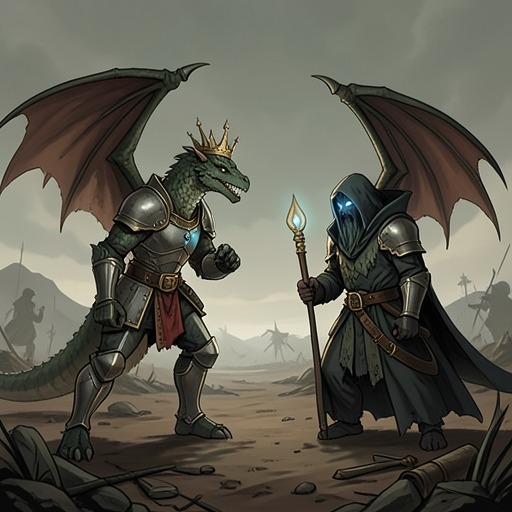
Furibon is an undead lich, specifically a former archmage of Ishfania. His body is unmistakably monstrous but presented with the ornament of high status. He is a skeleton larger than those of most of the smaller races, with a long serpentine neck, a manling-like skull, golden-looking bones, jewel-like teeth, and empty eye sockets glowing purple. He has long, thin arms but no legs; magic keeps him airborne. His red and purple robes resemble the costly garments of living wizards, while a crown completes the image of a sorcerous ruler. The crown immediately attracts Vainqueur’s covetous attention, creating a visual contest between Furibon’s authority and the dragon’s appetite for treasure.
His appearance also establishes the character’s particular kind of horror. Furibon is not an unseen or vaguely legendary threat once he arrives; the narrative displays the dead body in elaborate detail, then lets the cold purple light, levitation, and jewelry-like remains make status and decay coexist. The result is less an ordinary corpse than a royal parody of life: wealth, magic, and rank have survived, while the living body has been stripped away.
Castle of Murmurin and Allegiance
Castle of Murmurin was once an officer-training facility for the continent’s elite and the headquarters of the Ishfanian Inquisition. At the beginning of the Century War, Brandon Maure sent Furibon to seize it. Furibon transformed the fortress into a refuge for fiends, and his occupation awakened the volcano on which the castle had been built. The Ishfanian Inquisition fought the demons but failed to restore control, leaving the castle with a reputation for terror and supernatural danger.
Furibon therefore enters the plot not as an isolated monster but as the representative of a larger military and demonic power structure. He is both commander and proprietor, using a former institution of elite training and inquisitorial authority as the foundation of a fiendish stronghold. When he meets Vainqueur and Victor aboard their flying hoard, he identifies himself as Furibon, archmage of Ishfania, and greets them as intruders in his home. His polished welcome is inseparable from the threat behind it: the castle is a civilized surface covering an environment organized for violence.
Furibon has also been informed about Vainqueur’s earlier exploits. Brandon Maure warned him that Vainqueur and Victor had helped Gardemagne retake Rochefronde by destroying Maure’s chosen agents and had stolen the Apple of Knowledge. Furibon recognizes that the visitors have already examined the artifact’s forbidden knowledge and asks whether they have come to return it. His words show that he understands both their political importance and the value of the object they carry; he is not merely defending territory, but protecting the interests of his master and the secrets connected to the Apple of Knowledge.
Powers and Conflict with Vainqueur
Furibon’s most decisive attack is not a conventional blow but an assault on the meaning of Vainqueur’s hoard. He invokes the spell [Transmute Gold to Lead], and the entire treasure pile changes from beautiful gold into dull lead in a flash of dark magic. The attack strikes at Vainqueur’s identity as directly as any physical wound could. The dragon is left too shocked to process what has happened, because Furibon has converted the object of his desire into a useless burden without destroying it in the ordinary sense.
The spell recurs later, turning Vainqueur’s anticipated income into another disaster. Vainqueur calculates that four hundred coins per level would become forty thousand coins each month, or half a million each year, once he reached level one hundred. At the moment when wealth appears mathematically assured, Furibon again casts [Transmute Gold to Lead]. The coins become lead with black magic, and Vainqueur immediately recognizes Furibon as the source, with the lich’s bony finger still crackling with sorcery. This repetition makes Furibon the embodiment of the dragon’s recurring fear that wealth can be rendered worthless in an instant.
Furibon remains dangerous even after the apparent defeat of his body. He teleports beside his former corpse, surrounds himself with dark magic, and casts [Ancient Meteor]. A huge fiery stone strikes Vainqueur in the eye before exploding, giving the dragon a painful sensation he has never experienced before. The scene turns Furibon’s apparent removal into a reversal: distance and bodily destruction do not end the threat, because teleportation and spellcasting allow the lich to re-enter the fight at the moment his enemies believe the danger has passed.
The central confrontation is consequently a struggle between two competing forms of possession. Vainqueur wants Furibon’s crown, castle, treasure, and prestige; Furibon wants to preserve his fortress, his magical power, and the political interests of Brandon Maure. Gold, bodies, artifacts, and even magical identities become transferable objects. Furibon’s transmutation makes that instability literal, while Vainqueur’s eventual claim that he slew Furibon during the First War of the Hoard converts the encounter into part of the dragon’s public legend.
Immortality and the Scythe
Furibon’s immortality depends on a phylactery. When his body is destroyed, his soul returns to the phylactery, allowing him to create a new body. He describes this process as immortality, but Victor Dalton challenges the explanation rather than accepting its self-glorifying label. Victor reasons that Furibon’s soul must inhabit the current body; if the body were merely an animated puppet, Furibon could abandon it immediately instead of waiting for his enemies to destroy it. The exchange exposes a practical vulnerability beneath the lich’s boast: immortality preserves continuity of consciousness, but it does not make every vessel expendable or every defeat meaningless.
Furibon admits that he moved the phylactery to a hidden crypt on another continent when Vainqueur threatened to destroy Castle of Murmurin. He promises to return and rain spell after spell upon the survivors, but Victor’s response makes clear that the threat has become personal and strategically legible. The phylactery gives Furibon a route back into the world, yet its concealment also confines him to a predictable cycle of body, destruction, and reconstruction.
Furibon later becomes able to communicate through Victor’s scythe. Victor addresses him at the weapon’s edge, where the lich’s ghastly face materializes, and confirms that Furibon can hear and answer him. The scythe thus becomes both prison and medium: Furibon is no longer simply a flying archmage commanding a fortress, but a voice housed in one of Victor’s weapons. His continued consciousness preserves his personality, while his new condition deprives him of the independence and grandeur that defined his earlier appearance.
The transformation is especially humiliating because the scythe is associated with Victor, whom Furibon once regarded as a living intruder and enemy. Victor can question him about the Apple of Knowledge, call him by shortened forms such as Furi, and address him as an inconvenient source of information. Furibon’s survival therefore becomes a form of enforced service. He has escaped death, but immortality has carried him into a condition in which his enemies control the circumstances of his speech.
Relationships and Later Role
Furibon’s primary allegiance is to Brandon Maure, whom he calls his lord and master. That relationship places him within Maure’s campaign against Gardemagne and explains his hostility toward Vainqueur and Victor. Furibon does not present himself as an independent revolutionary or a misunderstood guardian; he speaks as an agent defending his master’s claims, his castle, and the forbidden knowledge connected to the Apple of Knowledge.
His relationship with Vainqueur is defined by mutual contempt and incompatible valuations. Vainqueur sees Furibon as a source of loot, a bearer of an enviable crown, and an obstacle between himself and a greater hoard. Furibon sees Vainqueur as a destructive dragon whose reputation already includes the defeat of Maure’s agents. The conflict is therefore material and symbolic at once: Vainqueur wants to accumulate and display, while Furibon repeatedly demonstrates that accumulated wealth can be altered, nullified, or weaponized against its owner.
Furibon’s relationship with Victor is more complicated because Victor becomes the channel through which Furibon remains present. Victor questions the lich’s immortality, identifies the logic of the phylactery, and later addresses him through the scythe. The exchanges are antagonistic but intellectually focused. Victor does not merely attack Furibon; he studies the mechanism of his survival, then turns that knowledge into leverage. Furibon’s continued existence consequently depends on the attention of the manling he once expected to kill.
After Vainqueur promotes Victor to his first and only friend, Furibon reacts from inside the scythe with disgust, saying, "I want to puke," and comparing the spectacle of their friendship to a disease of excessive sweetness. The remark preserves his old disdain while revealing his changed position. He is no longer the central commander receiving living visitors at Castle of Murmurin; he is an unwilling spectator forced to endure Vainqueur and Victor’s emotional bond.
At the Bragging Day celebration, Vainqueur publicly claims that he slew the dread Furibon during the First War of the Hoard. The declaration folds the lich’s defeat into Vainqueur’s self-fashioned heroic history, alongside the later defeat of the Moth King and the discovery of the ancient dragon system. Furibon’s actual continued presence in the scythe makes the boast darkly comic, but it does not erase its political function: Vainqueur uses Furibon’s name as proof that he is the Defender of the Hoard.
Furibon also serves as the flying Grand Vizier’s scythe and participates in the reconstruction of Vainqueur’s hoard. After the battle, the surviving minions return their magical items as tokens of fealty, and the scythe is thrown onto the treasure pile with the other offerings. The scene reduces a former archmage and fortress lord to an item within the dragon’s recovered collection. His body and castle once defined his authority; now even his weapon-bound existence is counted among Vainqueur’s possessions.
Narrative Function and Significance
Furibon functions as a recurring antagonist whose powers challenge the assumptions that normally organize Vainqueur’s world: that treasure remains valuable, that a defeated enemy stays defeated, and that death ends a character’s agency. His first transmutation turns gold into lead; his second repeats the violation at the precise moment Vainqueur imagines future riches; his meteor attack proves that bodily destruction is not final; and his phylactery makes survival dependent on a hidden object rather than on the apparent body.
He also dramatizes the book’s comic inversion of heroic and monstrous hierarchies. Furibon is genuinely formidable, visually terrifying, politically connected, and magically skilled, yet his grandeur is repeatedly repurposed by Vainqueur’s greed and boasting. The lich’s crown becomes a desired prize, his fortress becomes potential real estate, his defeat becomes advertising, and his scythe becomes part of a hoard. The grotesque humor comes from the collapse of his former distinction: the immortal archmage survives, but survival does not preserve dignity.
At the same time, Furibon’s presence gives Vainqueur’s rise a concrete opponent. Vainqueur’s later title, Defender of the Hoard, depends partly on claiming that Furibon’s destructive magic was overcome. Because Furibon can still speak, complain, and remember from inside the scythe, the story refuses to make the victory entirely clean. The defeated enemy remains audible within the triumph, turning conquest into an ongoing argument between the dragon’s self-mythologizing and the lich’s contemptuous corrections.